Printing with NetCom
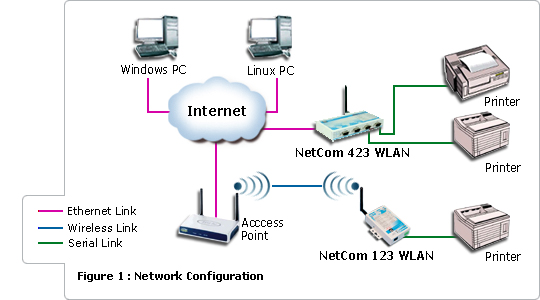
Sometimes the NetCom Serial Device Servers are used together with serial printers. These printers are available via a network to
several stations for printing (Figure 1). So far there have been two operation modes to achieve this.
First the serial port can operate as a TCP Raw Server, and the station just sends the data to print via a TCP connection.
As second option a computer running Windows could install the driver for virtual serial ports. The printer is then controlled
via this Com port. In both these solutions the buffering of data occurred on the client station.
Beginning with Firmware Version 2.2 the NetCom Devices offer a true Print Server mode, using the Line Printer Daemon protocol as
of RFC1197. Here a print server (lpd) is a station with one IP Address and a single defined port to accept commands and data for
printing. Several printers may be attached to the print server.
Each printer has a separate data queue for management of print jobs. The data of the jobs is saved in this queue, instead of
the client as before.
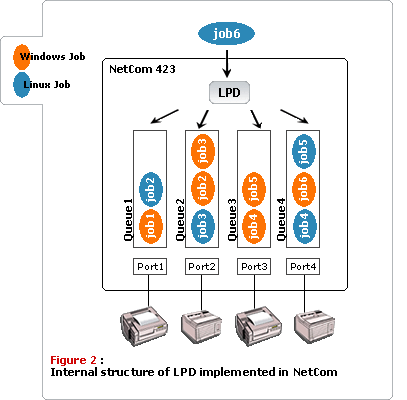
Internal structure of LPD implemented in NetCom
The basic function of an lpd is to accept the data for printing, store it in a spooler queue, and send it to the printer when
this is ready for printing (Figure 2). This is done for several queues in parallel. Each printer is identified by the name of the
queue, where it is attached to.
The NetCom Device Servers allow to configure a custom name for each queue, while the default name is lpd plus the number of
the serial port (lpd1, lpd2, ). This name is set in the properties of the serial port. When the lpd is running on a separate
computer, the hard disk is used to save the data of the queues. The NetCom Servers neither have a mass storage device, nor huge
amounts of memory. Each queue accepts at least one job with a size of up to 250 KB print data.
If the job has more data, memory is either assigned dynamically to save the job, or the data is spooled through a ring buffer.
Data is printed while the client still sends data. The amount of available dynamic memory depends on the number of ports in a
NetCom Device Server, and the operations active on these ports.
You can purchase VSCOM's products easily from a wide variety of leading technology distributors or partners.
Please call us or contact us by mail to find the best ordering method for your needs.
All the trademarks and brands are property of their rightful owners.